Stepped vs Level Life Insurance: What’s the Difference?
Stepped vs Level Life Insurance NZ: What’s the Difference?
Life insurance is about providing financial protection for the people and commitments that matter most.
If you were to die unexpectedly, life insurance can provide a lump sum to help your family manage the mortgage, debts, living costs and other financial commitments. For business and farm owners, it can also play an important role in business continuity and succession planning.
One of the key decisions when taking out life insurance in New Zealand is whether to choose stepped or level premiums.
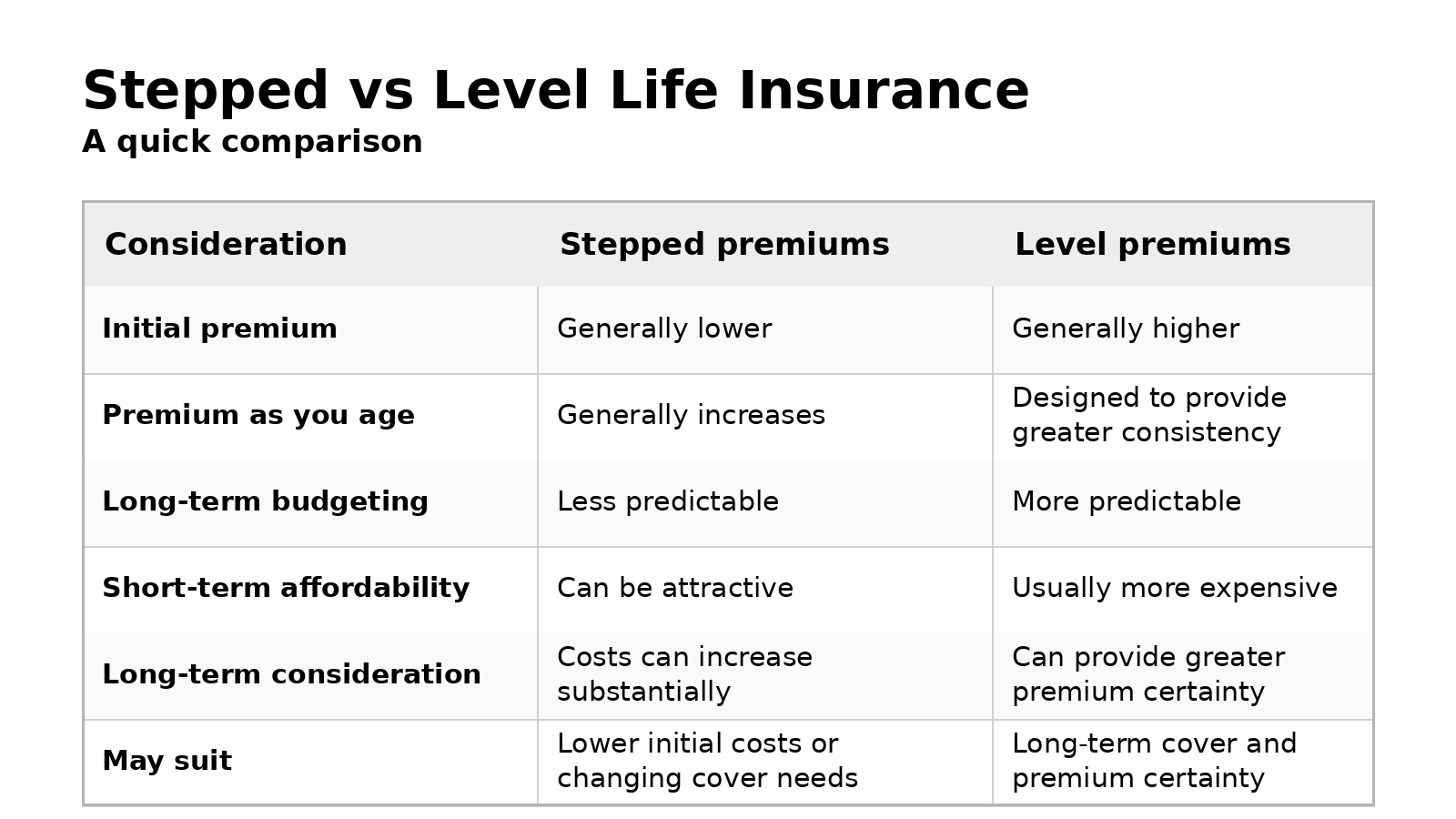
While stepped premiums can start cheaper, they generally increase as you get older. Level premiums generally cost more initially but are designed to provide greater consistency around the underlying cost of your cover over the longer term.
So, which option could be right for you?
What is stepped life insurance?
With stepped life insurance premiums, the cost of your cover generally increases as you get older.
When you're younger, the likelihood of a claim is statistically lower, so the initial cost of cover can be relatively low. As you age, the premium generally increases to reflect the increased risk.
For example, someone in their 30s may initially pay a relatively modest premium for $500,000 of life insurance. As they move through their 40s, 50s and 60s, the cost of maintaining that same amount of cover will generally increase.
Benefits of stepped premiums
Lower initial cost
Stepped premiums can be cheaper when you first take out your policy.
More affordable when you're younger
For people with a mortgage, young children or other expenses, keeping the initial cost of insurance down can be important.
Can suit changing insurance needs
If you expect your need for life insurance to reduce over time, stepped premiums may be worth considering. Your mortgage may gradually reduce and your children may eventually become financially independent, meaning you may need less cover later in life.
Things to consider
Premiums generally increase with age
The cost of your cover generally increases as you get older.
Long-term costs can become significant
Although stepped cover may be cheaper initially, premiums can become considerably higher later in life.
Future costs are less predictable
It can be more difficult to budget for your insurance over the long term when premiums are expected to increase.
What is level life insurance?
With level premiums, the aim is generally to provide greater consistency in the cost of your cover rather than having premiums increase simply because you have moved into an older age bracket.
You will generally pay more for level premiums when you are younger compared with stepped premiums. In return, you may have greater certainty around the underlying premium structure over the longer term.
Some insurers offer level terms through to age 100.
It's important to remember that level premiums don't necessarily mean your premium can never change. Changes to your amount of cover, policy conditions, insurer pricing, inflation adjustments and other factors can still affect the amount you pay.
Benefits of level premiums
Greater long-term certainty
Level premiums can make it easier to plan your future insurance costs.
Can work well for long-term cover
If you expect to need a significant amount of life insurance for many years, level premiums may be worth considering.
May become more attractive over time
Although you generally pay more initially, you may benefit from the premium structure if you maintain your cover for many years.
Things to consider
Higher initial cost
The biggest downside is generally the higher premium when you first take out the policy.
You may not need the same amount of cover forever
Your financial commitments can change significantly over time. You may pay off your mortgage, build savings and investments, or no longer have financially dependent children.
Not necessarily the cheapest option
If you only need your life insurance for a relatively short period, paying a higher premium upfront may not provide the long-term benefit you were expecting.
Stepped vs level life insurance: what's the difference?
Which life insurance option is right for you?
There isn't one option that's right for everyone.
When comparing stepped vs level life insurance, it's important to look beyond the premium you'll pay this year.
Consider:
- Your current age
- How much life insurance you need
- Your mortgage and other debts
- Whether you have children or other dependants
- How long you expect to need the cover
- Your current income and budget
- How your financial position could change in the future
- Whether you prefer lower premiums now or greater long-term certainty
For example, a younger homeowner with a large mortgage may have very different insurance needs from someone approaching retirement with little debt.
Your life insurance should reflect your circumstances rather than simply choosing the cheapest premium available today.
Can you change from stepped to level life insurance?
Depending on your insurer and policy, there may be options to change how your premiums are structured.
However, changing your policy isn't always as simple as switching from one option to another. Your age, health, existing policy, level of cover and the insurer's terms can all be relevant.
Before making a change, it's worth understanding how the new premium structure compares with your existing policy over both the short and long term.
Don't cancel an existing life insurance policy until you understand what replacing it could mean for you.
How can your life insurance needs change over time?
Your life insurance needs aren't necessarily going to stay the same throughout your life.
You might:
- Buy your first home
- Increase your mortgage
- Have children
- Change jobs or income
- Start a business
- Pay down your mortgage
- Build up savings and investments
- Have children become financially independent
These changes can affect both the amount of life insurance you need and the type of premium structure that may make sense for you.
That's why reviewing your insurance regularly can be just as important as choosing the right policy in the first place.
Life insurance and business or farm succession planning
For business owners and farmers, life insurance can serve a purpose beyond simply protecting your family. It can also form part of a wider business or farm succession plan.
This can be particularly relevant where a business or farm has significant value, debt, multiple owners or family members who may eventually take over the operation.
Providing funds for succession
Imagine two people own a business together and one dies unexpectedly. The surviving owner may want to purchase the deceased owner's share so they can continue running the business.
Without a plan, the surviving owner may need to find a substantial amount of money to fund that purchase, potentially by taking on additional debt or selling business assets.
A life insurance policy can potentially provide funds that help facilitate this type of ownership transfer, depending on how the policy and ownership arrangements are structured.
Helping with farm succession
Farm succession can be particularly complex where a farm is intended to remain within the family.
For example, parents may want one child to take over the farm while still wanting their other children to receive a fair share of the family's estate.
Life insurance can potentially provide a source of funds that helps create greater flexibility when dividing an estate, rather than requiring the farm itself to be sold or placing a large debt burden on the next generation.
Why level premiums can be worth considering
Succession planning is generally a long-term exercise. A business or farm owner may expect to retain ownership for many years before the eventual transfer takes place.
In this situation, the increasing cost of stepped premiums may need to be considered carefully.
Level premiums can provide greater certainty around the underlying cost of maintaining life insurance over the longer term. This can be useful when insurance is being maintained as part of a succession strategy rather than simply to cover a short-term financial obligation.
The important point is that level cover isn't automatically the right solution for every business or farm owner. The appropriate structure depends on the succession plan, ownership arrangements, age of the owners, amount of cover required, affordability and how long the insurance is expected to be needed.
Business and farm succession requires more than just insurance
Life insurance should generally be considered as one part of a wider succession plan.
Business and farm owners may also need to consider:
- Who will take over the business or farm
- How ownership will be transferred
- What happens if one owner dies
- Existing business or farm debt
- The value of each owner's share
- How other family members will be treated
- Whether a buy/sell agreement is appropriate
- How insurance ownership and proceeds should be structured
- Tax and legal considerations
- What happens if an owner becomes seriously ill or unable to work
Getting the right legal, accounting and financial advice is important when putting these arrangements in place.
Life insurance in Invercargill and Southland
If you're looking for life insurance in Invercargill or Southland, it can be helpful to speak with an adviser who can look at your wider financial situation rather than simply comparing premiums.
At Corcoran Smith Financial, we help individuals, couples, families and businesses understand their insurance options and put cover in place that fits their circumstances.
Whether you're buying your first home, protecting an existing mortgage, starting a family or reviewing your existing insurance, we can help you understand the options available.
Frequently asked questions about stepped and level life insurance.
Is stepped or level life insurance cheaper?
Stepped premiums are generally cheaper initially, while level premiums generally cost more at the beginning. However, the total cost can look very different over a longer period, so it's important to consider how long you expect to keep your cover.
Do stepped life insurance premiums increase every year?
Not necessarily every year. However, stepped premiums generally increase as you move into older age bands. The exact way premiums are calculated and reviewed depends on the insurer and policy.
Does level life insurance stay the same forever?
Not necessarily. Level premiums are designed to provide greater consistency, but your premium can still be affected by factors such as changes to your level of cover, policy terms, insurer pricing or inflation-related adjustments.
Can I change from stepped to level premiums?
This depends on your insurer and policy. Before making a change, it's important to understand whether new underwriting or other conditions could apply and how the new structure compares with your existing cover.
Is level life insurance better for younger people?
Not necessarily. It depends on how long you expect to need your cover, your budget and your future financial plans. A younger person may benefit from the lower initial cost of stepped premiums, while someone expecting to keep substantial cover for many years may consider the greater long-term certainty of level premiums.
Should I choose stepped or level life insurance?
The answer depends on your individual circumstances. Rather than simply choosing the cheapest premium today, consider how your premiums could change over time and how long you expect to need your life insurance.
How much life insurance do I need?
This depends on your debts, mortgage, income, family circumstances, dependants, assets and the level of financial support you want to provide if you were to die.
An adviser can help you work through these factors and determine an appropriate level of cover.
Talk to a Southland life insurance adviser
Choosing life insurance isn't just about finding the cheapest premium.
The choice between stepped and level life insurance can affect what you pay today, what you could pay in the future and how sustainable your cover is over the long term.
If you're based in Invercargill, Southland or elsewhere in New Zealand and want to review your life insurance, Corcoran Smith Financial can help you understand the options and find an approach that fits your circumstances.
Get in touch with Corcoran Smith Financial to discuss your life insurance options.
Get in Touch and Let’s Discuss Your Financial Needs
Whether it’s for your KiwiSaver Investment, personal or business insurance, or your home loan, contact us today for a chat about how we can help you.